It has taken me well over a month to get through six verses. Today I get through seventeen? Whoo-wee, that’s some fast reading.
As we go through the following days there is a bit of a pattern that if we are not careful can lead us into a bit of a sing-song mentality and our brains check out at the door. The day begins. God speaks something into being. Day ends. God sees that it’s good.
One of the strange things I noticed when I began looking closely at Genesis is that the days don’t go like that at all. There are unique situations and unique words throughout. Once again I was a product of a simplified theology that was appropriate for my age and ability in Sunday school. I did not, however, delve deeper until now.
So this is a warning that we are about to get really wordy with things because these words illuminate and deepen the flannel graphs of our childhood. It’s quite a bit like going from 2-d to 3-d.
Beginning in verse 6 we see that one of the things that delights God is the ability for things to grow, for things to be in a state of flux that improves the situation for all. This is shown to us by His seeing that one thing or another is “good”. The first time that God sees that something is good is in verse 4. After He calls light into being he sees that it is “good”.
In the Hebrew the word used here is “tob” which, as an adjective, means “good, pleasant, agreeable (to the senses and to the higher nature) valuable in estimation, prosperous.” All these synonyms lead us to understand that things that are “tob” are capable of causing other good things to happen. As good builds on previous layers of good we will end up seeing that the things that are “tob” lead to a fruitful world that happens as a result of God’s creative choices.
The world that we are watching God create here is one that is intentionally full of life, full of prosperity (as He sees it rather than how our limited minds would determine it) and interconnected in such a way as to be for every living things’ welfare. We can observe this in the world around us very easily by seeing how the process of life occurs.
At its most basic level all creatures and all of the things that possess life are deeply interconnected. The herbivore eats a plant. A carnivore eats the herbivore and, through defecation and death, the carnivore’s remains feed the plants. In a strange way, herbivores get their revenge by eating the plants sustained by the carnivore. But it all factors into a grand wheel, as Disney’s “Pocahontas” reminds us, that never ends and simply creates more and more life.
Plentiful and fertile life cannot exist without light. Plentiful and fertile life cannot exist without land. So, that which increases life is considered “good”.
One of the most abhorrent so-called gods whose worship got under God’s divine but metaphorical skin the most was Molech. The thing that God found so disgusting was Molech followers would sacrifice their own children. The records we have available regarding worship of Molech tell us that his idol was made out of bronze, and he had his hands outstretched to the supplicant. A fire was tended underneath those hands which kept them hot. Anything placed in those hands would burn up instantly. The sacrifice that meant the most, that gained his ultimate favor, to Molech was the sacrifice of babies. When we see that God is pleased by life and the fruitfulness of His creation, is it any wonder that this makes Him furious? The worshipers of Molech were not just ending the life of one child but a whole potential line of successive human generations were snuffed out of existence because someone wanted a thing. What makes the loss of a human more important than the loss of a herbivore? Well, we will get to that.
God declares the waters should gather together and dry land appear. He personally names them “Earth” and “Seas”, and then He calls for this freshly named Earth to sprout vegetation. The Earth does as it is told and all manner of plants sprout and grow, not just for itself but so that it will propagate more of its own kinds. Once the Earth does this, once it’s fruitful and life sustaining, then God calls this state of affairs “tob”.
Following this God creates the lights within the expanse of the heavens whose job it is to separate day from night, and to provide signs for seasons, for days and for years. It’s quite interesting that here we see God going beyond the next logical step. He is clearly planning many steps ahead to the humans that will need to use these signs. Cows and goats have no need of the stars. I’ve never heard of any animal that looks up at the stars. They don’t need them. Humans, however, have used the stars to travel massive distances and predict the coming of winter, and the coming of dooms and kings. Well, one King in particular. I can’t help but wonder if God smirked a little as He made the stars and appointed one star in particular for that specific task it would burn the most brightly for thousands of years later.
Interestingly, when it comes to the Sun and the Moon, the text doesn’t say that God “let there be”. It says that He made them. Everything else created so far was done with words. Here God does something special.
The Hebrew for “made” here is the word “asa”, which means to fashion, wrought, to work on, deal with, to labour with. It may be that they already existed, having been begun with His words, and God further worked on them to improve them; to better “good”inate them. The other option is that He wrought them from materials on hand, already spoken into existence. Interestingly it is the same word used for when Adam and Eve sew fig leaves together. It is also the same word used when God confronts the humans and the snake in the garden. “What is this thou hast done?” is literally “What is this thou hast made?”
There is clearly a very special thing going on with the sun and the moon in that He specifically places them in such a way as to give the best light to the earth. He set them in a very precise place and relation to the earth so as to provide maximal blessing. God sees, only after this direct action of His, that it was “good”.
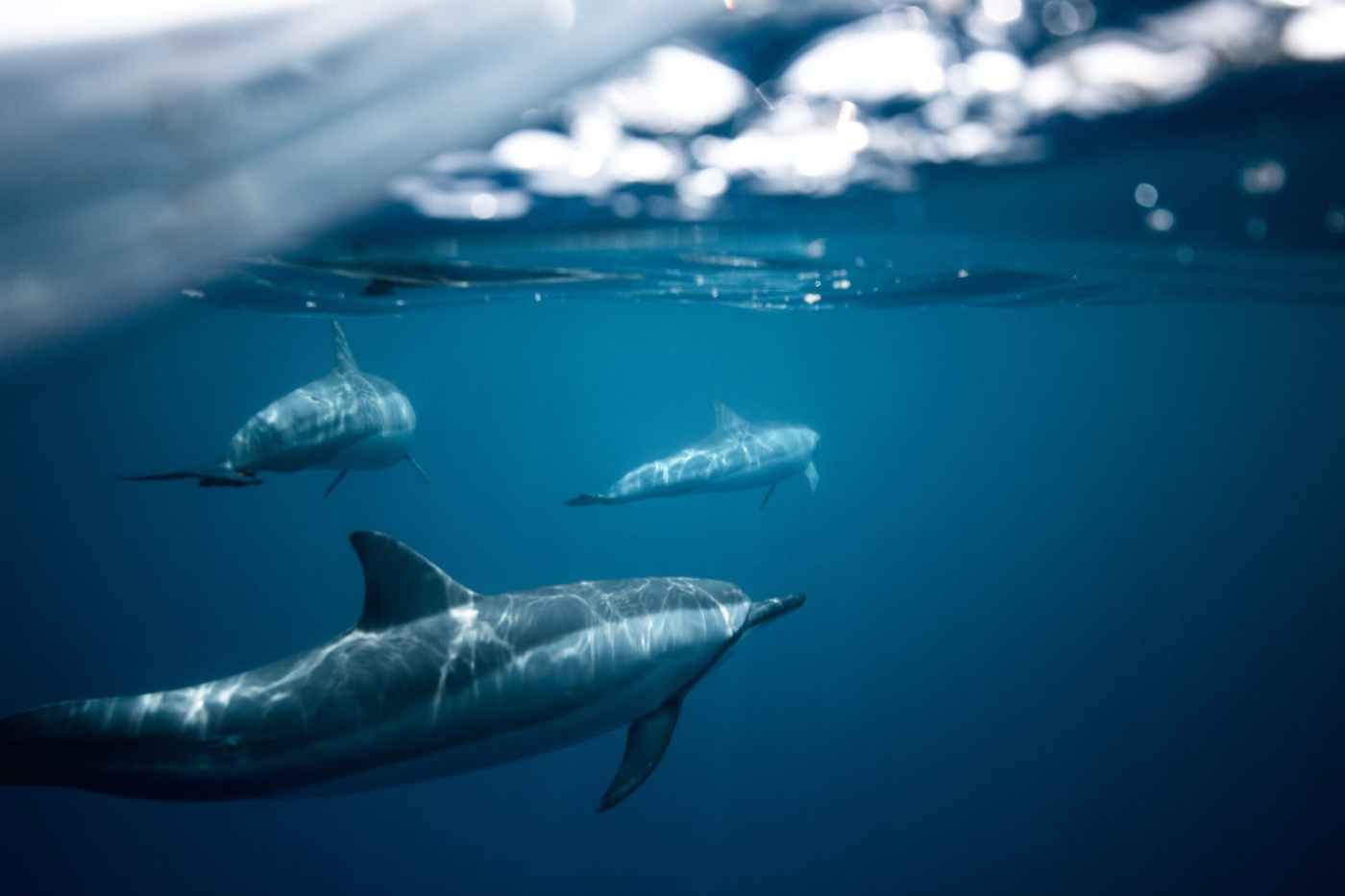
The next day begins with the typical “let there be” but something strange, something more attentive, more intentional happens here again. God “creates” the great sea creatures, everything that moves within the waters, and the birds of the air. Its almost like after the Sun and the Moon He can’t stop being personally involved, because that word “creates” is the word “bara”. It means to “cut out, pare down, to plane and polish.” These are something I recognize as woodworking terms. The substance is already there, but the carver refines it, manipulates it from the block to the intended item. It’s only after this meddling that God pronounces this aspect of creation as maximally beneficial, or “good”.
Then God does another thing He has yet to do. He blesses them.
With the word “blessed” I did exactly the same as all the other words, expecting it to blow out my little assumption lens. The word used here is “barak” and it is one of the rare straight across translations that I’ve found. It literally means “blessed”. I actually felt a little let down by that and had a good chuckle at my reaction. It means the same in Hebrew and English? What?! How can this be?!
There was one illuminating thing that did come out as I proceeded to examine context and connection in other places were “barak” is used. There are two modes of blessing. God blesses us. We bless Him. To bless God means to glorify him, to adore and praise Him. When God blesses us, He does something for our benefit. How God blessed the animals of the sea and air?
God says in verse 22, “Be fruitful and multiply and fill the waters in the seas and let the birds multiply on the earth.”
God’s blessing, His benefit to these creatures of sea and air, is a command. A command to be fruitful and multiply. That strikes me as a strange kind of benefit, really. Giving them something to do? He blesses Humans with a similar charge.
Life is a blessing. Children are a blessing. Doing what it takes to make a child in this world is a blessing. Caring for a child until it is able to run and thrive and succeed and make children of its own is a blessing. We so casually curtail, minimize, or avoid that blessing. Maybe it’s a command because once we see what difficulty it brings so many of us say “Nah, I’ll just sit this part of God’s existence and established order out.”
Uniquely, one of God’s admonitions to His people later in the Bible is, “Be different the way I am different.” There are many contexts that we could apply to that, many aspects of God’s divine personality that we could shine through that prism, but it seems to me that here we could say, “Be obsessed with life and abundance like I am obsessed with life and abundance.”


 Finding Narnia
Leave a comment