On this day two-thousand years ago our Lord and savior was abandoned by His disciples, and betrayed into the hands of the religious and political elite to be falsely accused, mocked, beaten, tortured, and then murdered. He stood utterly alone. It was a night of a long desired final meal, grieving prayer, and watching as those around Him fell asleep, misunderstood His entire mission, ran away, and denied even knowing Him. The question that always hangs in the air as we read this section is, “Would I have done any differently?”
This Lenten season I am using the “Every Moment Holy” Lent study. Today’s entry was about what fears of failure we might have in regards to our Faith. What types of failure do we fear, which character do we relate to the most, and how might we allow that weight of fear to die and resurrect as something new this Holy Week?
I have a massive fear of failure.
If you get beyond a basic acquaintance level with my I’m very open about what I call my “negative perfectionism”. You see, someone who is a standard perfectionist tends to work obsessively to make something as perfect as possible. Often they demand the same perfectionism from others and especially those they work closely with. A perfectionist will spend hours expending effort and emotion to make spotless something that no one will see, but it bugs them because they would know it wasn’t clean.
What I refer to as “negative perfectionism”, on the other hand, is characterized by knowing that something I do is never going to be perfect enough so why bother. When something isn’t perfect that they work on with others, the negative perfectionist will find every reason why it’s their fault that it wasn’t perfect before they would ever blame others.
I fear not knowing enough, not being able to learn enough or figure out enough to get it right. I so want to do well enough that upon entrance to heaven I will hear, “Well done, good and faithful servant”. However, I relate all to well to the third servant in the Parable of the Talents who knew his master’s standards and desires, and in response dug a hole in the ground to keep his one coin safe. It wasn’t that he didn’t love his master. It wasn’t that he didn’t want to do well. It was that he doubted himself, doubted that he could turn a profit, and especially feared taking a risk and making a mistake that would lose all of what the master gave him. And as such, I’m also afraid that I’ve screwed up too much already; that I’ll never be able to make up for the loss.
When I write it out like this, I can easily see how riddled with ridiculousness this mentality is, how false and faulty my thinking is. Is my salvation somehow based on how capable I am? How smart I am? Is it established on the basis of how well I can make up for the wrongs I have done? Certainly not. Emphatically not.
My salvation, and yours, is based solely on God’s Grace, Love, and Mercy, and continues as I move, run, walk, stumble, and/or crawl towards Him by emulating His Son.
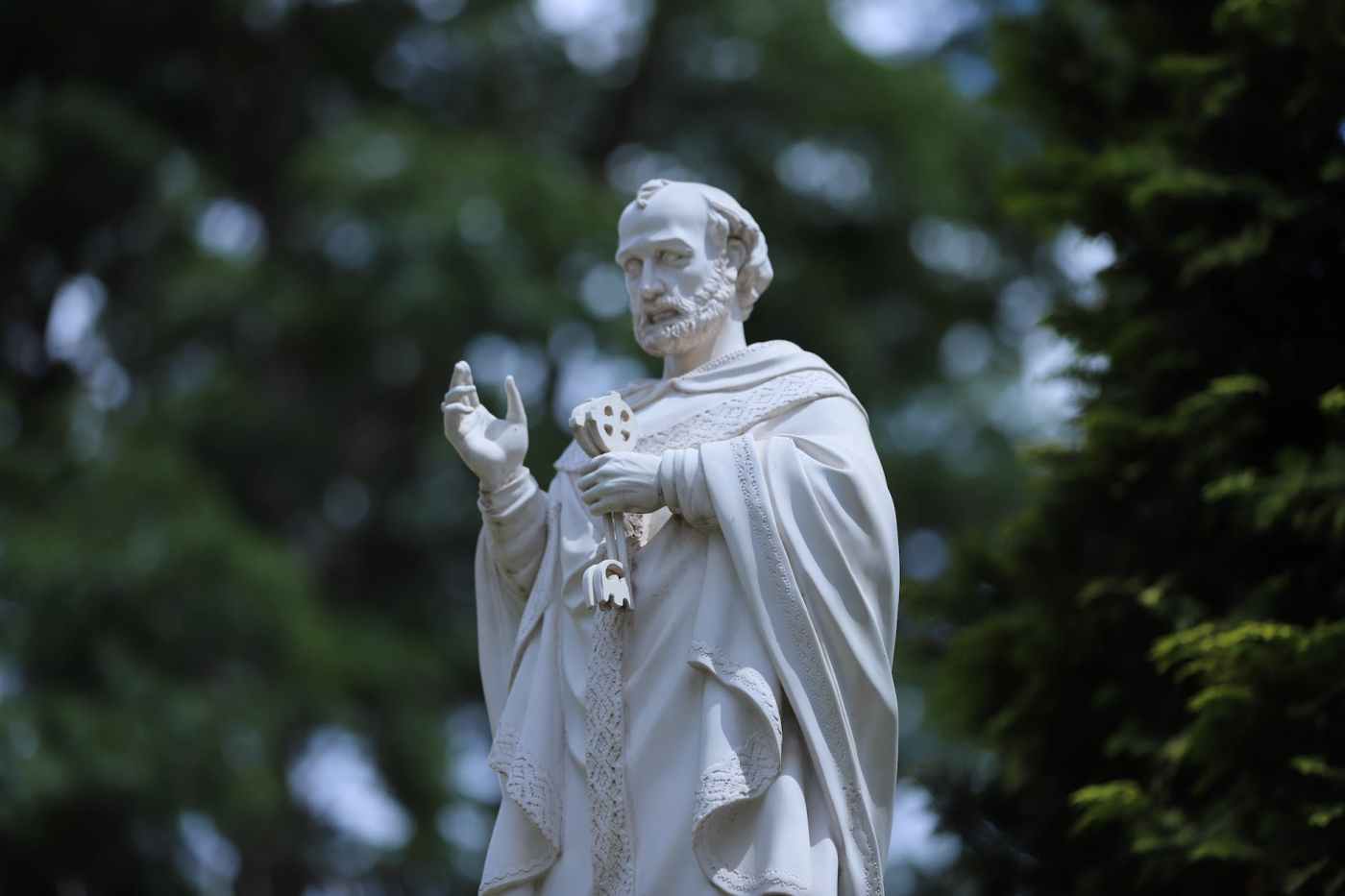
Peter is particularly helpful and sympathetic as an example. Most might consider this in the light of his three time denial of Jesus, but I go to somewhere else in the story for my reference point. I relate to the moment where Peter draws his sword and strikes the High Priest’s bondservant.
He fully believed that he was doing the right thing, the good thing. Peter was defending his Rabbi, and the Messiah of all Israel. Why shouldn’t he take up the sword? History was on their side. The throne belonged to Jesus and Peter was going to make sure that no one touched the Son of David. Hadn’t he just told Jesus earlier that he would die rather than deny Him? Of course he laid into the man. Honestly, the servant was lucky he only lost an ear.
Jesus then did what He always did. He showed them that they had misunderstood everything. Instead of being praised, Simon was rebuked for doing exactly the wrong thing: the opposite of what Jesus wanted. Peter was told that he’d misunderstood everything that the Kingdom of God was about. Jesus was right, of course. He could have asked God for legions of angels. Then why didn’t he? And then Jesus reached down into the dirt of the Garden of Gethsemane, picked up the servant’s ear, fixed Peter’s mistake in judgement, and then submitted to the mob to be taken away.
Peter’s confusion must have been absolute and his entire paradigm for living over the past three years totally upended. Is it any wonder they all fled? Is it any wonder that they were tossed into confusion, panic, and disarray? They had gotten it wrong. They had all misunderstood. And they all failed. They didn’t know enough. They didn’t understand. They didn’t know what to do.
I fear that moment with the sword; getting it so wrong and doing exactly the wrong thing. Misunderstanding what I am supposed to do. Doing more damage than good to the point that Jesus has to then come along and clean up after me. All because I operated under faulty thinking presenting as good intentions. Woe is me.
The temptation for me is to bury my Talent in the ground, to do nothing with it, to risk nothing because then I’ll do no damage for sure. I might gain nothing but at least I won’t have lost anything. But that is not the righteousness that God requires. I’m tempted to leave it to others to do and be and proclaim and enter into deep community because what if I hurt others? What if I get hurt by others?
Jesus’ answer for me is the same as Jesus’ answer for Peter.
After the resurrection, Peter gets itchy feet and decides to go fishing. Jesus appears on the shore and there is this beautiful reunion scene that I can’t wait to see portrayed in “The Chosen”. They sit around, Jesus and the disciples, eating fish on the shore and Jesus has an interaction with Peter that is almost heartbreaking.
The damage was done, the resurrection occurred, and Jesus had already revealed Himself and taught them. I’m sure Peter would have been fine if Jesus never brought any of it up again, except it’s also true that Jesus is as obsessed with Shalom as God the Father is, for obvious reasons. For three denials He has three questions. We find this in John 21. Jesus asks Peter three times if he loves Him.
In looking into the original language there is an amazing thing going on here they’d you’d never get. It’s just Jesus asking Peter if he loves Him. Peter says yes twice and then gets emotional on the third one because Jesus keeps asking. Each time Jesus tells Peter to feed His sheep. It is far deeper than first glance.
The first and second time Jesus asks Peter, He uses the word Agape. Each time, Peter uses Phileo. Really the interaction goes like this.
“Peter, do you completely unconditionally love Me more than these?”
“Yes, Lord; You know I love you like a brother.”
“Peter, do you completely unconditionally love Me?”
“Yes, Lord; you know I love you like a brother.”
This creates a textured tension that the English translations simply can’t convey. Jesus is asking Peter twice if he loves Him with the highest form of love and Peter honestly replies in the affirmative. He then admits he only loves Him with the same love as a brother.
I imagine the heartbreak in Jesus voice as He asks for a third time…this time not asking if Peter loves Him with that highest of loves, but instead asks,
“Peter, do you love me like a brother?”
Peter gets visibly upset. The scriptures tell us that Peter is grieved that the Lord would ask him a third time about his love for Him. I wonder if the grief has more to do with the fact that the Lord has asked him for a higher love than Peter has available at that moment and is now settling for a brotherly love. Jesus’s desire is for a higher love from Peter, and yet meets him at his level of ability at that moment.
It makes sense to me as I look at my weakness and failings, my impurities and mistakes made. He wants it all, and I have not yet been capable to give Him my all. As I noted, I’m scared to try and more frightened to fail because I want to love Him more than I do. I want to be found faithful. I don’t want a mark on my record. I don’t want to be Peter and I really don’t want to be that one follower of Jesus who apparently showed up to the garden in just a towel and had to run off naked because someone grabbed it. And yet Jesus’ demand isn’t that I don’t make a mistake. Jesus’ desire is not that I should only make perfect investment decisions and never unintentionally waste my time effort or ability. The answer is the same as for Peter.
“Feed my lambs. Shepherd the members of the flock that are moving forward. (That’s the literal translation of the second command). Feed my sheep.”
It doesn’t matter how I look or if I can squeeze out an unqualified success. I am, and you are, to invest in the Kingdom at some risk to ourselves. Don’t hide it in the ground. Don’t put it under a bushel. Make an investment. Extend yourself. Because safe isn’t where Jesus called you to be.
Feed. Jesus’. Sheep.
As always, thank you for reading. If this touched you, made you think a little differently, or know someone who could use this perspective, please like, share, and subscribe.


 Finding Narnia
Absolutely beautiful. Definitely sharing this, even if I’m a day late in finding it. May God continue to guide and bless your efforts.