Beginning in verse 5, we begin the aside narrative regarding the creation of Adam and Eve. What was simply a passing reference in the first chapter we now get details about. I couldn’t help but wonder “Why?”.
There is quite a bit of detail that the Bible leaves out throughout the entire book. Details about Heaven, Hell, the immortal soul, angels and demons, the war in heaven, etc. are hinted at in places but never directly explained. This is especially true of the Five Books of Moses. It can be infuriating for someone like me who craves understanding and knows that those details could only increase understanding. Given this lack of details, when the Bible does give details, when it deliberately goes back and zooms in on a section, that indicates that there is a lot more going on in the piece than meets the eye.
What we get in this second chapter of Genesis is the establishment of the relationship between God and Mankind, Man and Woman, and all three of these to the Earth. We begin with God’s relationship to the Earth, oddly enough.
Beginning in verse 5, we are given the setting. All of the potential for bushes and plants existed but had not yet sprung up. The Earth was watered by a mist going up from the land. All of the conditions were right for flourishing but there is a heavy implication that it was waiting for God to create man in order for it to be activated into full blossoming life.
In these waiting conditions, the LORD (Yahweh, bless His Name,) descends to Earth and, from the dust of the ground, He forms man.
Here is where I geek out every time I read this passage:
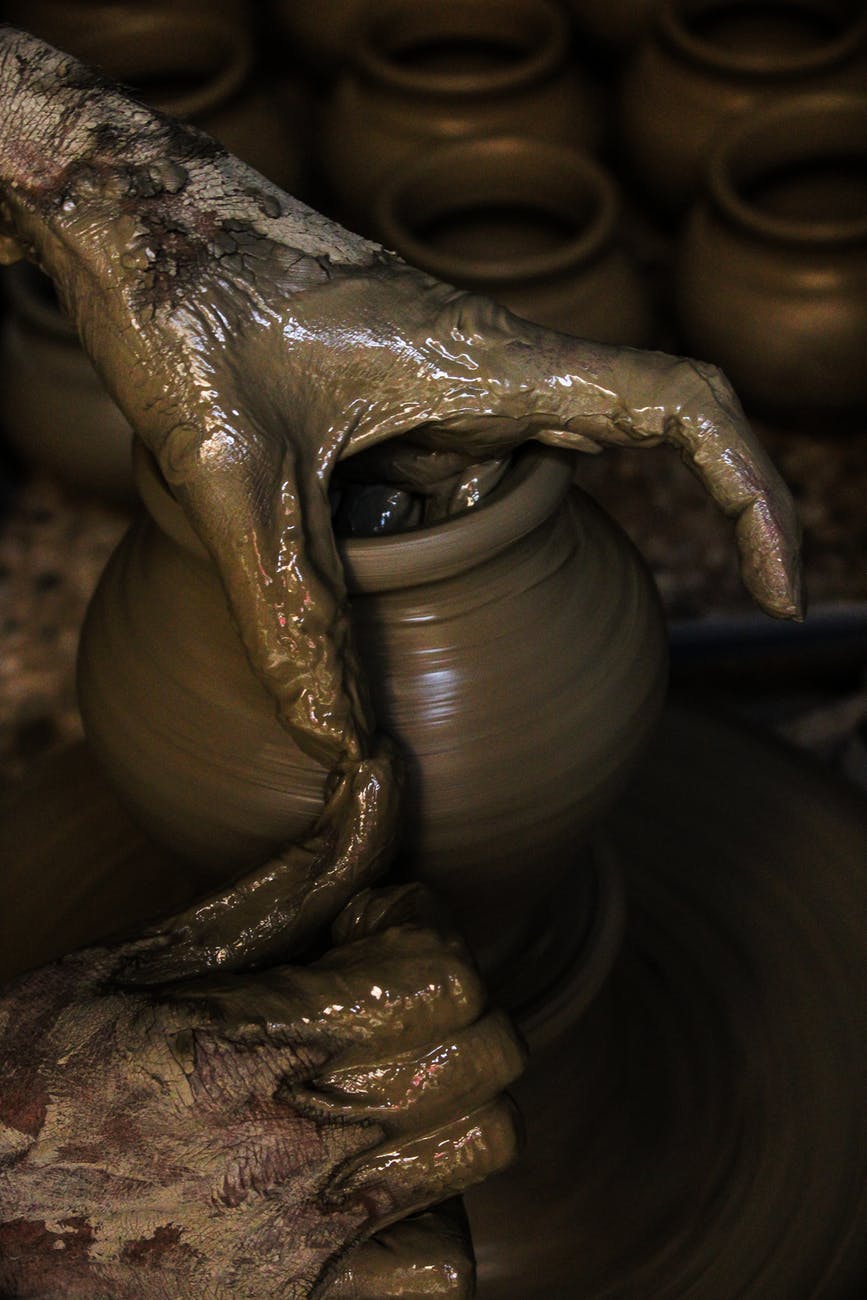
God Himself, comes down from Heaven, reaches into the dirt that was already a created thing, and makes something wholly new from it. God got his hands “dirty” to create man. Remember that before, when He was “fashioning” or “refining” the various groups of creatures, He took an already created thing and just smoothed the edges. Here God is, once again, doing something completely new; making a brand new creature not with words, but with His hands and using an already created thing in order to do it. The language here for “formed the man of dust from the ground” is explicitly in the context of a potter creating a clay pot.
Naturally, when we considered the making of a clay pot we think of a potter at a wheel. He just takes the lump, flips a switch, and begins to shape said lump as it spins round on the machine. Primitive notions of making clay pots are a whole other process; a far more detailed process. The potter would take clay and roll it out into ropes like you probably did with play dough back in kindergarten. Instead of using the centrifugal force of potter’s wheel, the form of the pot was created in layers of these ropes from base to height. These were then smoothed with water applied to the fingers, and countless strokes as every bump was melded into a surface uniformity inside and out. The idea here is a much more time consuming, attention consuming, “intimate” and intentional construction than our modern vision of the process. God didn’t just go “Poof” with Adam. I would not be at all surprised if God Himself made out of clay every bone, every vessel, every nerve, every muscle, joint, tendon, fingernail and hair follicle. Why do I say that? Because next He breathes into the creature, this Adam, the breath of life and “the man became a living creature”. Adam didn’t get refined with the breath of life. He became alive with the breath of life.
(An aside: What an interesting moment here where God breathes into Adam’s nostrils the breath of life. We would expect Him to breathe it into the man’s mouth, no? Maybe this is because we have a cultural osmosis basic understanding of mouth to mouth resuscitation as a life saving measure and we assume it must have been the same as a life granting measure.)
We were made from the substance of the Earth by God, given the breath of life by God, to be in relationship with God and to serve God by tending, subduing, and being good stewards of His creation. We are created by the Divine Will from the stuff of the Earth in order to know/experience/replicate the image of the Divine and take care of the Earth. There is a beautiful symmetry to that. I’m fully aware that this is just a simple layer that has a depth of complexity undergirding it that I could spend a lifetime studying and likely not reach the bottom of. But this is who we are, what we were created to be and to do. This is the bargain basement, no frills, unvarnished truth of our existence. No matter how much we overcomplicate it with our logic, rhetoric, ideologies, pop doctrine, psychology…the Truth always comes down to this. For us to be happy, for us to be whole, for us to be at peace, I believe we have to start here, not add it onto everything else like an app, an accessory, or a browser extension.
In the original language, when it says that man “became a living creature” the indication appears to be that with that Divine breath, man’s mind, heart, soul and ability to live were all instilled in an instant. He was likely not a domesticated, simple creature at the moment of consciousness. It was apparently as if all of the code for “humanness” was downloaded onto the blank hard drive in an instant and the device was powered up…with breath from God. Fascinating.
With Man v1.0 booted up, (I joke here. There was not an upgrade that I can see given all of human history. Maybe the impartation of the Holy Spirit in the book of Acts could be considered a patch? It’s a horrible metaphor the longer I think about it but I’m leaving it here anyway.) God turns His attention back to the Earth and God plants a garden in Eden in the East.
And with that, it’s time once again to blow up the “flannel graph board” from my days as a Sunday school student:
Adam wasn’t made in Eden. Eden was planted after Adam was created and the man was placed in the Garden from outside of the Garden. It occurs to me that this means that Eve was created in the Garden and likely knew nothing outside of the Garden. Did this contribute to why she believed the Serpent? Why she was willing to risk disobedience when all she knew was a walled garden? It makes me consider the words of Dostoyevsky who said that if you created an absolutely perfect Utopia the first thing people would do would be to break stuff just so something interesting would happen. But Adam knew that not every place was Eden.
Interestingly, God waters Eden differently than the rest of the Earth. Eden is located at the headwaters that eventually branches into four rivers, two of which are still flowing; the Tigris and the Euphrates. In even just this, Eden is a far more excellent place than any other. But then the LORD God causes “every tree that is pleasant to the sight and good for food” to spring up out of the ground. (Remember this quoted phrase above, dear ones. It’s going to become important in the next couple of posts.) In the midst of all of these trees that are there to greatly benefit man, stand both the Tree of Life and the Tree of the Knowledge of Good and Evil.
As usual, to our modern European way of thinking and processing, we have an instinct that there should be a breakdown of what these trees are, why God planted them if He is about to forbid them, what they looked like, what their fruit was to make sure we skip it in the produce section, etc. As usual, the Bible doesn’t satisfy that way of thinking. As usual, we have to simply pay attention and puzzle it out.
(As always, dear reader, if you made it to the end of this post please consider liking, commenting, sharing, and subscribing. All of those things do a world of good for encouraging me to continue writing my thoughts as a guy with just a brain and a Bible. Even if you don’t have the time to do any of that, thanks for reading at all. You’re pretty cool for even that.)


Leave a comment